
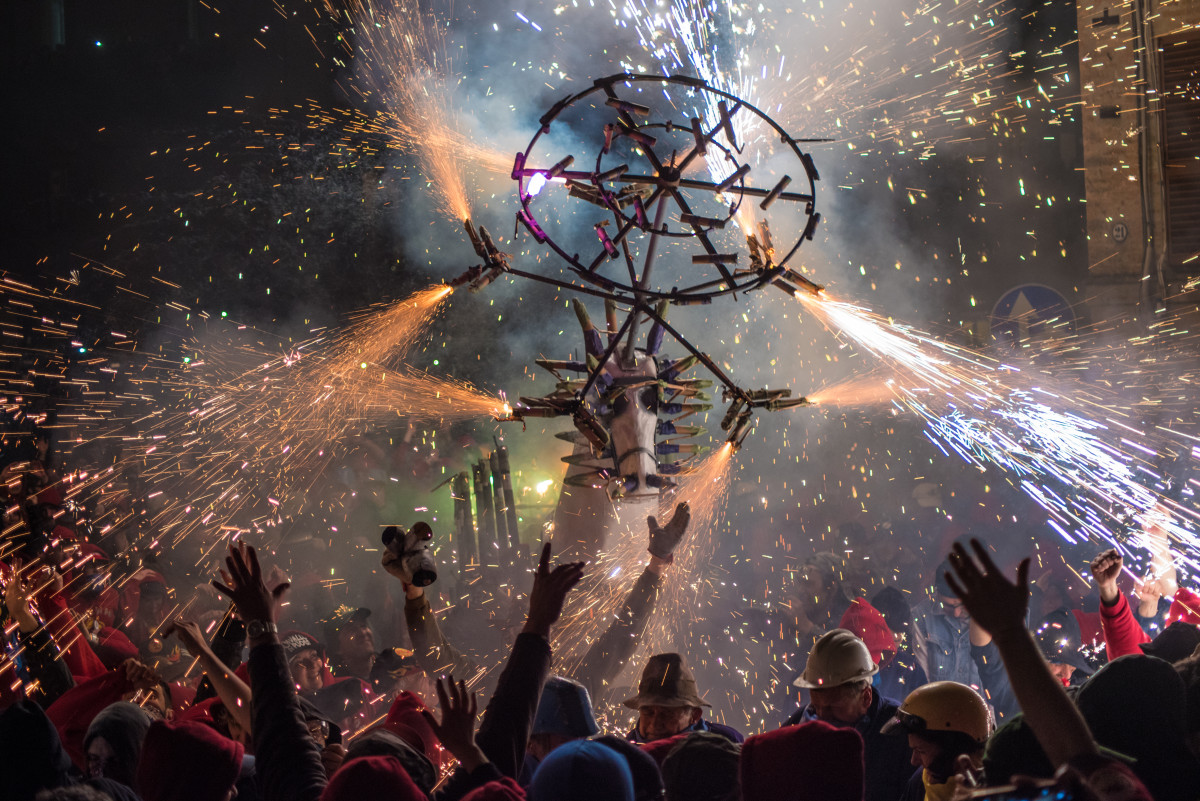
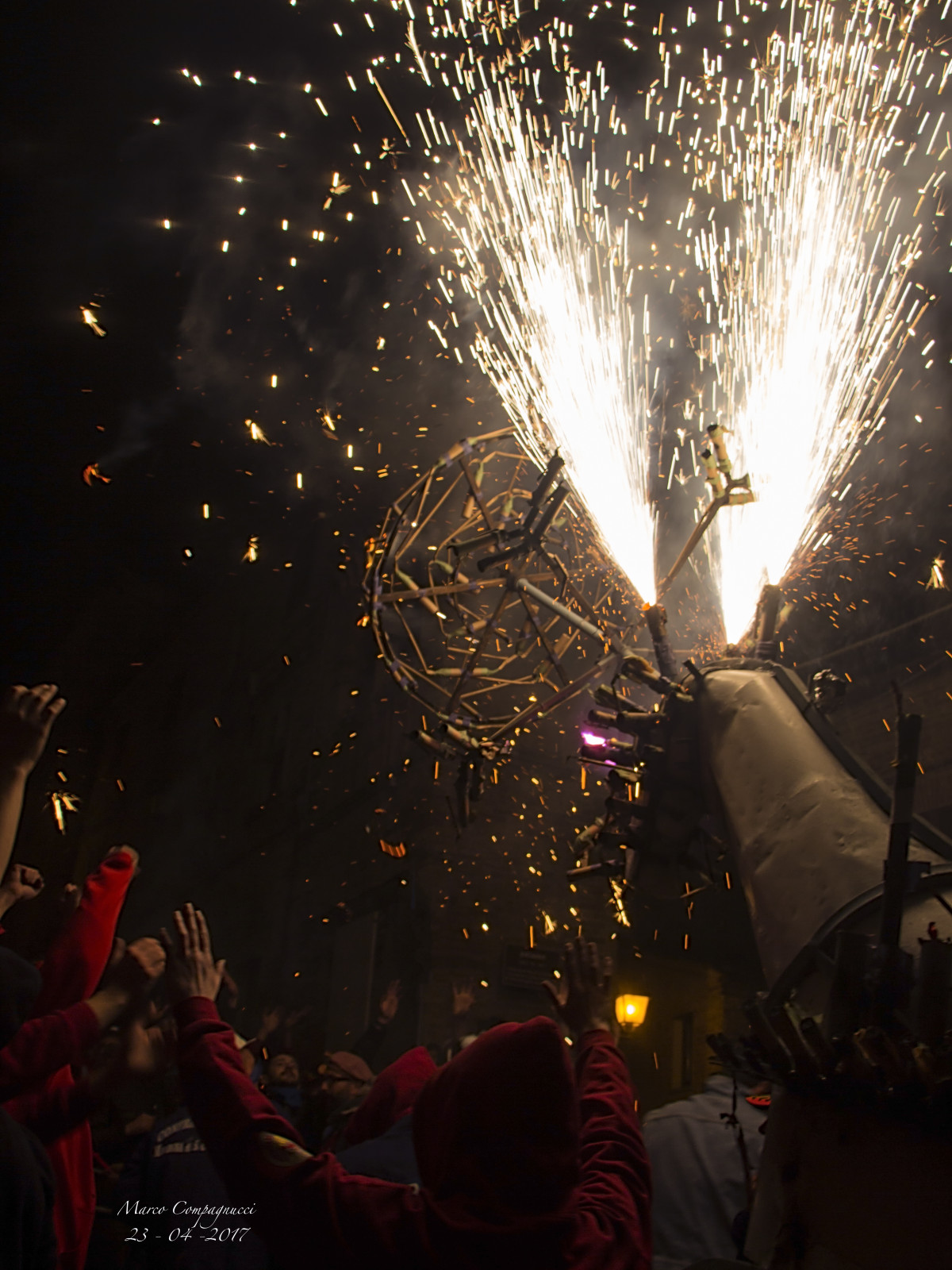
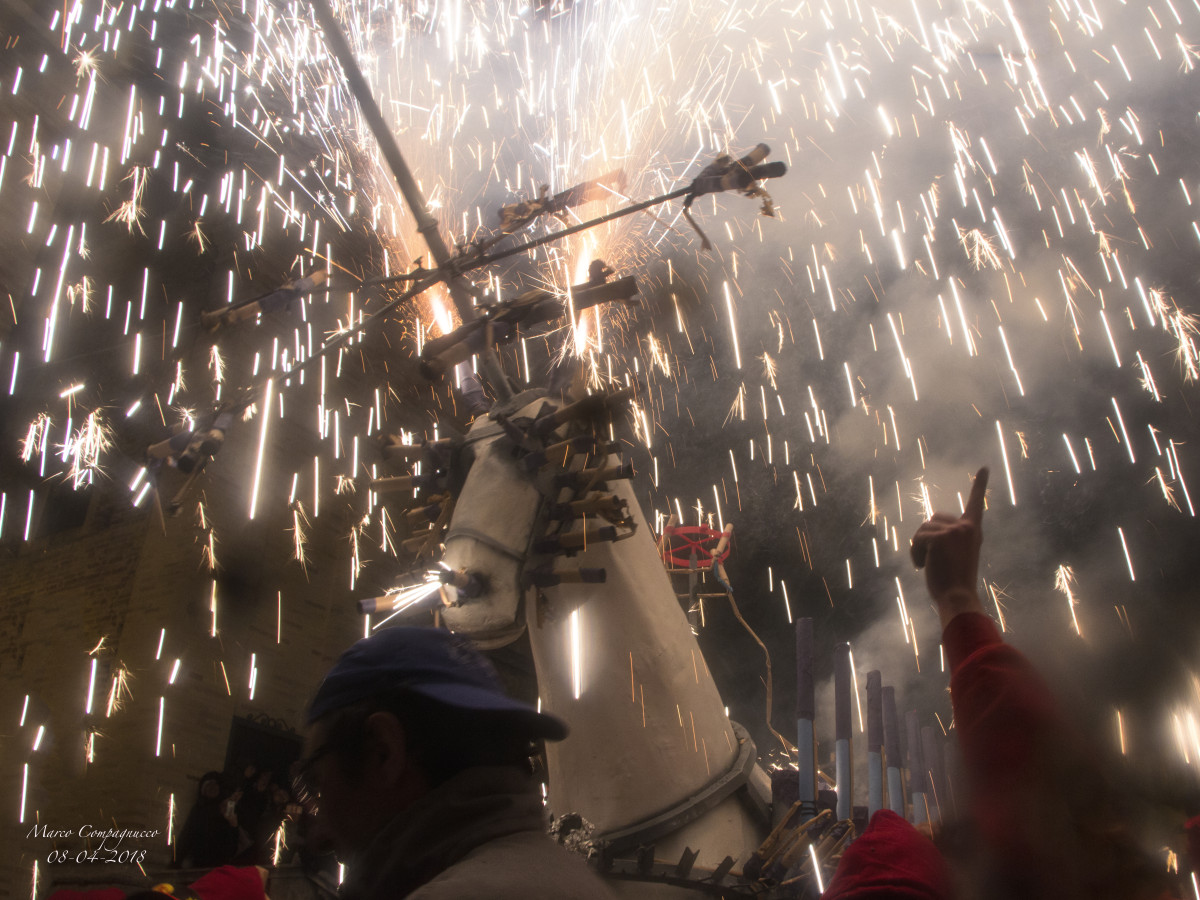
"Then (after the procession and the fireworks), the master who created the fireworks, who was called from Atri, rode a horse filled with fireworks, which he rode around the square several times, constantly shooting out rays and other bizarre creations made of bitumen and other similar incendiary materials. He looked just like Pluto when he emerged from Mount Vesuvius on a fiery horse to kidnap the daughter of Ceres." In this famous excerpt, Marquis Filippo Bruti Liberati describes for the first time what really happened on May 10, 1682, a crucial date in Ripatransone's history when the Fire Horse was born. This, along with 1205, the year of its establishment as a Free Municipality, is certainly one of the most important dates in the memory of Ripatransone, as it marked the beginning of an event that over the centuries has undoubtedly become the symbol of the celebration par excellence in this city. The Horse of Fire is therefore an indelible feature of its past and a concrete symbol of the immutability of tradition. It was Easter Sunday, May 10, 1682, when this skilled stoker, summoned for the coronation of the statue of the Madonna of San Giovanni, after completing his work with all his remaining supplies, improvised a show astride his horse. The people gathered in the square were so enthusiastic that a long and intense applause followed, accompanying the anonymous stoker's departure from town. What happened so enthused the people of Ripani that the following year, some citizens, mindful of what had happened, reenacted the event. And so a long tradition was born, destined to never disappear. Most likely, the Horse of Fire continued to be reenacted with a real animal until around 1700. Subsequently, the people of Ripani constructed a wooden model, carried on someone's shoulders; He must have been a robust man, because the model weighed approximately 65 kilos. The horse was led "a cezza" (as they say in dialect) until 1932, the year in which the first wooden model on two wheels was built. The technical characteristics of the Horse we see today were already all outlined; it had whiskers and a pinwheel (or swivel), from which the most fascinating fireworks were released. From 1878 to 1950, the person in charge of lighting the Horse was Luigi Lucadei (a member of the Misericordia confraternity at the time), who was known as "stuppì" (fuse) because of his role. By now, after more than two hundred years of re-enacting the Horse of Fire, this festivity had taken on the character of a "day of the year." The importance achieved by the actual shape was even comparable to that given to the statue of the Madonna of San Giovanni; Luigi Piergallini, a well-known figure from Ripatransone (who, after “stuppì” and Francesco Piergallini known as “'Ngeccù”, had the honor of lighting the Horse), author of books such as “Babbo, il Cavallo di Fuoco, e tanta gente ripani” (Baby, the Fire Horse, and so many people from Ripatransone), wrote: “A holy creature, held as dear as the apple of the eye… if the sparks end up on clothes, patience and many graces for the return of good fortune, practical justice of popular belief […]. For many other people from Ripatransone, it represented the symbol of devotion, of good fortune, of the overcoming of many illnesses, of the banishment of misfortunes. Was this faith?” During the Second World War, the Fire Horse was not celebrated for five years. This had repercussions on the population who, in addition to suffering the atrocities of the war, were unable to recall the much-loved festival; Luigi Piergallini also wrote: "They told me that, during the war years, old people and children had visited the horse several times to... say hello [...]. Was it possible that the Horse of Fire could cheer the spirits between one tear and another?" Before the Horse's official shed became the current one, it was located in a stable or warehouse, the location of which is unknown; the elders say that few were allowed into the Horse's shed, and very few knew what it was. This obviously increased the excitement of the city, which couldn't wait to see the Horse of Fire again on Easter Sunday. The wooden model was thus used until 1994, when craftsman Umberto Nucci built the new sheet metal model. It weighs 2.5 quintals, is 3 meters long, and 2.50 meters high. This latest Horse model generates much more spectacular firework displays than the previous ones, and thanks in particular to it, the number of people attending this event has grown dramatically.