
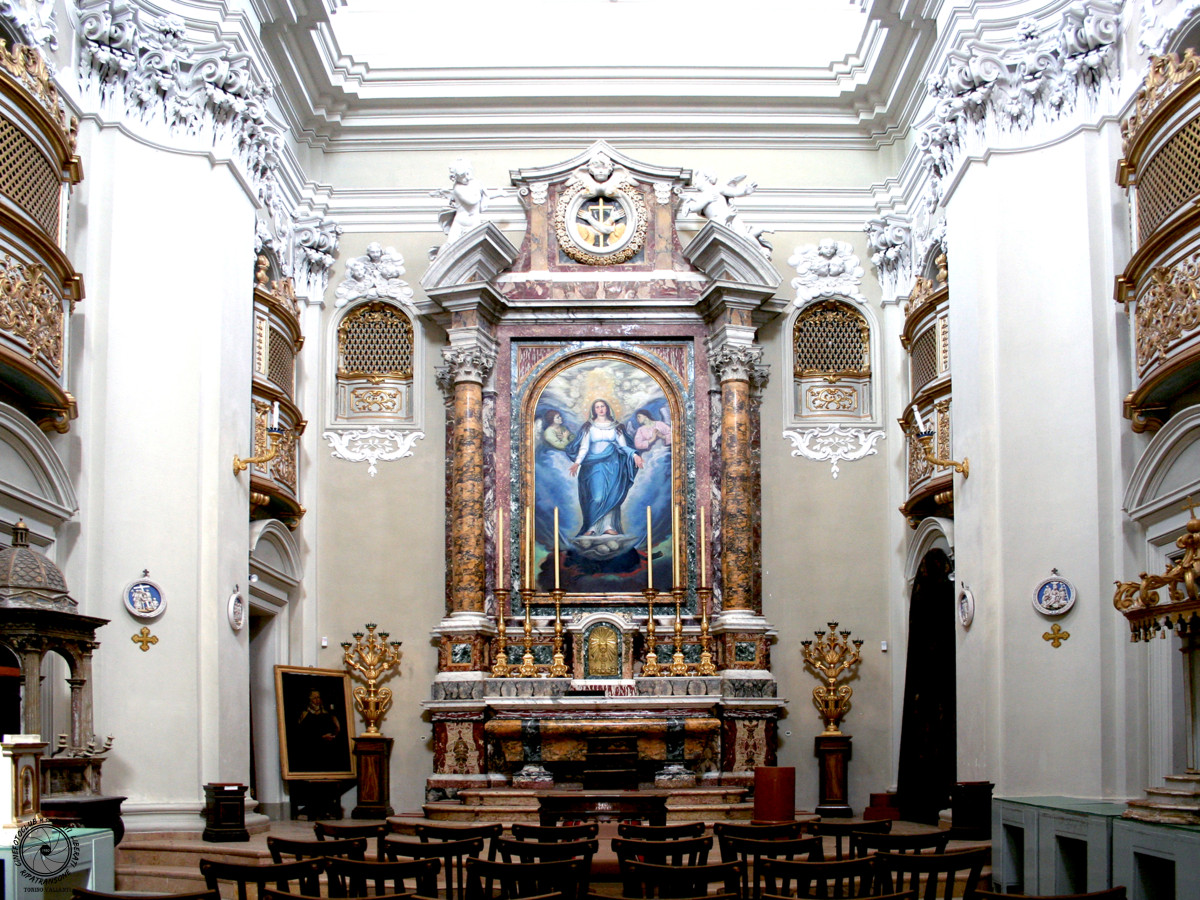
The Church of Santa Chiara was built by the Poor Clares between 1750 and 1753 and was consecrated in 1754. The façade is elegant and slender, as is the slender sandstone portal; the interior, with a single nave, is rich in momentum and grace, with pilasters adorned with beautiful Corinthian capitals; even more beautiful and well-preserved are the stuccoes and the nine gilded grates; the high altar, the most valuable in the city, is original as it is entirely covered with irregular and polychrome marble tiles; the altarpiece, the Immaculate Madonna (1960s), is the work of Michelangelo Bedini, also the author of the two paintings on the side altars: Saint Joseph with Baby Jesus (on the right), Sacred Heart of Jesus (on the left); on the cymatium of the high altar is the coat of arms of the Franciscan Orders, on the sides, two angels (sculptures); another statue, Saint Francis, is placed in the niche above; The epigraph on the last arch of the vault reads: "DOM In honorem S. Clarae." The 14 Stations of the Cross, majolica medallions imitating the Della Robbia style, were purchased in Rome in the 1960s, the period in which the church was restored and donated by Bishop Vincenzo Radicioni. Since April 1, 1999, it has been the worthy (albeit temporary) home of the Episcopal Museum of Sacred Art of Ripatransone, one of the eight Sistine Museums of Piceno, set up within the Diocese of San Benedetto-Ripatransone-Montalto. It houses vestments, reliquaries (half-bust and monstrance), and silver liturgical objects, primarily from the Baroque period. Also included are two canvases depicting Saint Clare, likely works by Nicola Monti of Ascoli (1736-1795), devotional art figurines, and three examples of "Cartegloria," one of which is carved and gilded wood, perhaps the most beautiful among those preserved in the churches of the entire diocese. It is surrounded by the Episcopal Seminary complex, consisting of the buildings on Corso Vittorio Emanuele II between numbers 95 and 99, the Church of Santa Chiara, and the long brick building facing Via Duchi d'Atri, designed by Giuseppe Rossetti (18th century).