
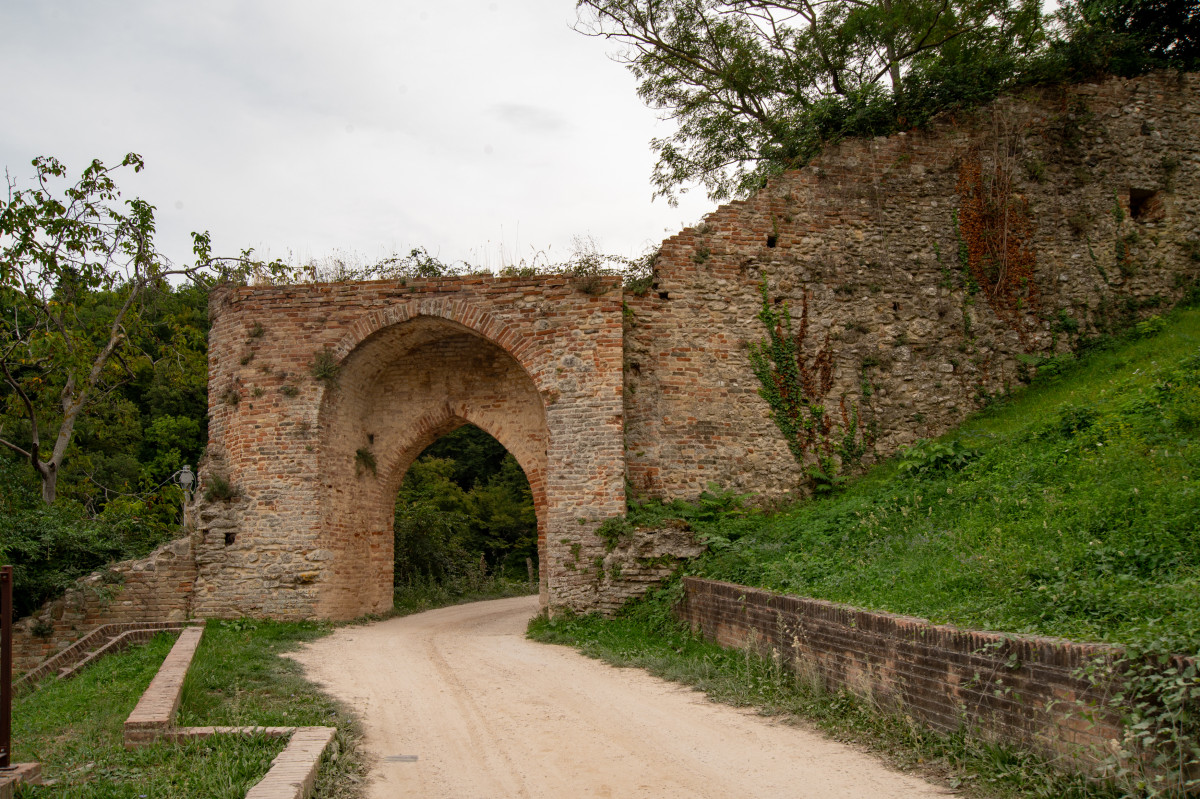
The walls and defensive towers of Ripatransone, almost certainly erected after 1205, the year of the "birth" of the free municipality, were in dilapidated condition following the assault by Francesco Sforza's troops in 1444. Thanks to the efforts of Francesco Lunerti, a citizen of Ripatransone, Pope Eugene IV granted Ripatransone a thirty-year tax exemption to facilitate its reconstruction. Further aid was granted by Giosia d'Acquaviva, Duke of Atri, who had ties of blood and affection to the city. Subjected to various interventions over the centuries, the medieval walls suffered serious damage in 1966-67 due to the widening of the "Cuprense" provincial road. Nonetheless, the walls of Ripatransone remain one of the most beautiful and complex fortified walls in the Marche region. The length of the wall perimeter, in a 19th-century engraving, is estimated at 2,418 meters; It follows the site's orography, which varies from neighborhood to neighborhood. As in the Middle Ages, the city is divided into the neighborhoods of Monte Antico, Capo di Monte, San Domenico (or Roflano), and Agello. The city walls are opened by several gates; the most beautiful is the Porta di Monte Antico. Facing south, with a square plan, it has a pointed arch; it has a projecting arrangement on a projection of machicolated corbels, except for the rear side and the left side inside the curtain wall it is inserted into. The tower had, as a second security (in addition to the main door), a portcullis located towards the inside of the entrance hall: of this, only part of the sliding seat remains. Just above the extrados of the entrance arch, an illegible coat of arms is walled up. The crenellated crown, although restored, is still equipped with Ghibelline battlements, some of which are equipped with musket slits; It is grafted onto a system of corbels and machicolations to provide both thrusting and penetrating defense. The Porta di Agello, also fortified, faces north. It once had a projecting structure equipped with machicolations limited to the sides exposed to a potential attacker, that is, those "extra moenia". The Porta di San Domenico displays a beautiful stone coat of arms built above the extrados of the archway; the crowning was equipped with a light projecting structure, which, although lacking a lead system, housed the battlements.